

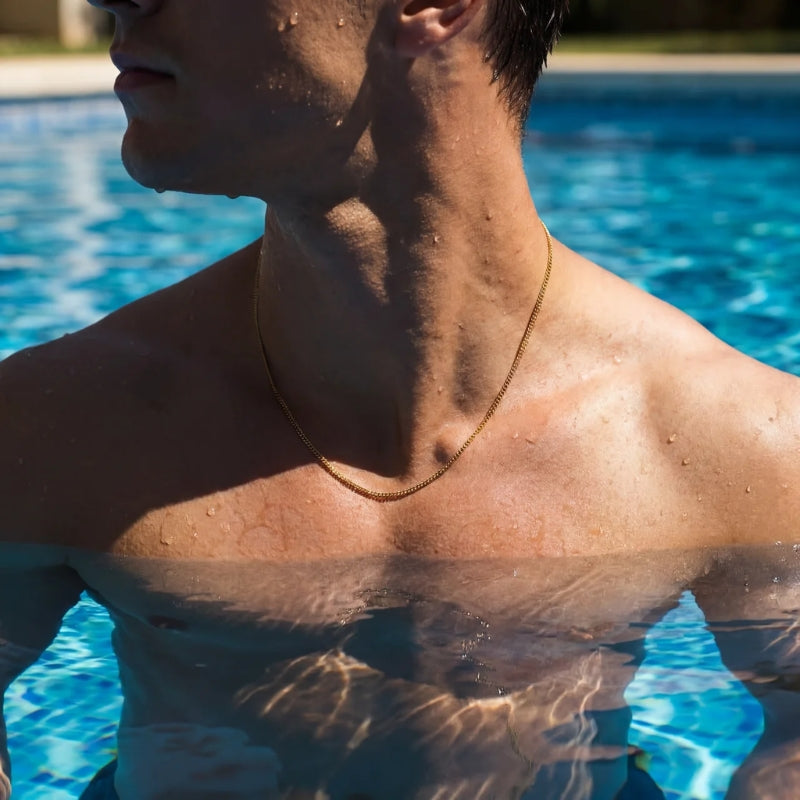
Does Stainless Steel Jewellery Tarnish? Men's UK 2026
No. And also, sort of.

- Quick answer
- What is tarnishing technically?
- Why 316L resists tarnishing
- When stainless steel jewellery appears to tarnish
- How to test if your piece is tarnishing or plating wearing
- How to prevent tarnish on stainless steel jewellery
- Stainless vs sterling vs gold filled tarnish behaviour
- Frequently asked questions
The short answer is that 316L stainless steel does not tarnish. The medical implant grade of stainless that sits inside surgical patients for decades doesn’t suddenly start corroding on your wrist.
The longer answer is that what people call “tarnishing” on stainless steel jewellery is usually plating wear. Your chain is 316L underneath, gold electroplated on top. When the gold layer fails, the silver-tone steel below shows through. Looks like tarnish. Isn’t tarnish.
Knowing which one is happening on your piece tells you whether you have a wear problem (replaceable) or a quality problem (the brand isn’t what they claimed).
You can see the current waterproof men's chains line-up for reference as you read.
Quick answer

Plain 316L stainless steel jewellery does not tarnish. It is the same metal grade used for surgical implants placed inside the human body. It does not corrode or oxidise visibly in normal wear conditions including shower, gym, sweat, parfum, swimming.
What looks like tarnishing on stainless steel pieces is usually one of three things:
- Gold plating wearing off (silver-tone steel showing through gold layer)
- Lower-grade stainless (304, fashion steel) which can pit slightly under heavy wear
- Surface dirt buildup (resolves with a wipe)
What is tarnishing technically?
Tarnishing is the surface chemical reaction between a metal and oxygen or sulphur in the environment, creating a dull or darkened layer (oxide or sulphide).
- Silver tarnishes by reacting with sulphur in air or skin, forming silver sulphide (the black layer)
- Copper tarnishes by reacting with oxygen and moisture, forming copper oxide (green-blue)
- Pure iron rusts by reacting with oxygen and water, forming iron oxide (red-brown)
Stainless steel resists tarnishing because the chromium content (16-18% in 316L) forms a passive chromium oxide layer on the surface. This layer is invisible, only a few atoms thick, but extremely resistant to further oxidation. As long as the chromium oxide layer is intact, the steel underneath does not corrode.
Tarnishing is the surface chemical reaction between a metal and oxygen or sulphur in the environment, creating a dull or darkened layer (oxide or sulphide).
Why 316L resists tarnishing

316L is specifically engineered for corrosion resistance:
- Chromium 16-18%: forms the passive oxide layer
- Molybdenum 2-3%: adds resistance to pitting from chlorides (sweat, pool chlorine, seawater)
- Low carbon (≤0.03%): prevents chromium from being “tied up” in carbides, keeping it free to maintain the oxide layer
This composition is the same as medical implant grade. Hip replacements, knee replacements, dental implants placed inside the human body for decades use 316L because it does not corrode in biological environments. Wearing a 316L ring on your finger for years is significantly less aggressive than being inside the body.
When stainless steel jewellery appears to tarnish
In men’s jewellery specifically, three scenarios cause what looks like tarnish:
1. Gold plating wearing off (the most common case)
Most men’s jewellery sold in the UK is gold-plated stainless. The piece looks gold on day one because of the plating. When the plating wears (3-36 months depending on plating type), the underlying silver-tone steel shows through.
This is not the steel tarnishing. The steel is identical to day one. The gold layer on top is gone in places. The visible result looks like “tarnish” but is technically plating wear.
This is the most important distinction for men’s jewellery buyers: when you see “tarnishing” reported on stainless steel pieces, it’s almost always plating wear.
2. Lower-grade stainless (304 or unspecified)
If a piece is labelled “stainless steel” without specifying 316L, it might be 304 or unspecified mixed-grade. These lower grades can show slight pitting under high chloride exposure (heavy sweat, pool chlorine over time).
This shows as faint dark dots or pits on the surface, distinct from plating wear (which shows as colour shift from gold to silver-tone).
For premium men’s jewellery, the brand should declare 316L specifically. If they only say “stainless steel” without grade, the metal could be anything.
3. Dirt buildup
Sometimes what looks like tarnish is actually accumulated grime: sebum, parfum residue, soap scum, dead skin. This affects all jewellery materials and looks like a slight darkening or dulling.
A wipe with a microfiber cloth or a 30-second wash with mild soap and water removes it. If the “tarnish” comes off this way, it was dirt, not actual oxidation.
If you see darkening or dulling on your stainless steel piece:
How to test if your piece is tarnishing or plating wearing

If you see darkening or dulling on your stainless steel piece:
Step 1: Clean it
Wipe with a microfiber cloth. If the darkening is gone, it was dirt.
Step 2: Inspect with a loupe or magnifier
- Plating wear: silver-tone metal showing through gold. Usually appears at high-friction points (link joints on chains, inner band on rings, plate corners on ID bracelets).
- Surface pitting: small dark dots on the surface. More uniform across the piece. Suggests lower-grade stainless.
- No visible change: if the piece looks identical under magnification but felt “darker” to you, it was probably dirt that has now been cleaned.
Step 3: Test with a magnet
Real 316L is non-magnetic or very weakly magnetic. If your piece is strongly attracted to a magnet, it might not be 316L. Cheaper stainless grades (some 410, 420) are magnetic.
How to prevent tarnish on stainless steel jewellery
For 316L specifically, prevention is mostly automatic. The metal resists tarnish by composition. What you can prevent is plating wear (if your piece is plated) and surface dirt.
For PVD-plated pieces (e.g. Monrich):
- Wear them. Daily. The PVD bond is durable.
- Avoid abrasives (scrubbing pads, harsh chemicals)
- Wipe occasionally to remove dust
For electroplated pieces (common across UK D2C brands):
- Avoid shower / pool / sea immersion to extend plating life
- Avoid perfume direct contact (spray first, jewellery second)
- Wipe with soft cloth daily
For unplated 316L (rare in men's jewellery, common in fashion):
- Essentially zero maintenance
- Avoid extreme chemicals (industrial cleaners, etc.)
- Wear it freely
For 316L specifically, prevention is mostly automatic.
Stainless vs sterling vs gold filled tarnish behaviour
| Material | Tarnishes? | What you see |
|---|---|---|
| 316L stainless (unplated) | No | No change in normal wear |
| 316L stainless + PVD gold | No (steel) + plating wears slowly (12-36 months) | Gradual silver-tone showing through gold |
| 316L stainless + electroplated gold | No (steel) + plating wears fast (3-6 months) | Silver patches visible at friction points |
| 925 sterling silver | Yes (oxidation/sulphidation) | Slow darkening, polishable with cloth |
| Gold filled | No in normal life (10-30 year lifespan) | No visible change for decades |
| 18K solid gold | No | No change |
Frequently asked questions
Does 316L stainless steel really not tarnish?
Yes. 316L is the medical implant grade of stainless steel specifically because of its corrosion resistance. It does not tarnish or corrode in normal wear conditions including shower, gym, sweat, swimming.
Why does my stainless steel chain look tarnished?
Almost certainly the gold plating is wearing off (showing silver-tone steel underneath), not actual stainless steel tarnishing. To confirm: inspect the piece under good light. If the “tarnish” is at link joints, ring inner bands, or high-friction points, it’s plating wear. The steel itself is unchanged.
Can stainless steel jewellery turn black?
True 316L should not turn black. If a piece is turning black, possibilities include: (1) the piece is not real 316L and is actually a lower-grade alloy oxidising, (2) the piece is plated and the plating is wearing exposing a darker base, (3) accumulated dirt that looks black but wipes off.
How long does stainless steel jewellery last?
The base 316L material itself can last decades in normal wear conditions. The plating (if applied) is the variable. PVD plating lasts 12-36 months. Electroplating lasts 3-6 months. The base steel doesn’t degrade.
Can you swim with stainless steel jewellery?
Yes for 316L. The base steel is fine in pool and seawater. If your piece is plated, expect the plating to degrade faster from chlorine and salt exposure. Unplated 316L is essentially indestructible in swim conditions.
Built after wearing the others.
Different by design.
PVD-plated 316L. 1-2 micron thickness declared. 12-month tarnish guarantee in writing. Permanent buy one get one free across the full catalogue.
Browse Monrich → UK shipping 2-4 days / 30-day returns / no customsShop the pieces mentioned


